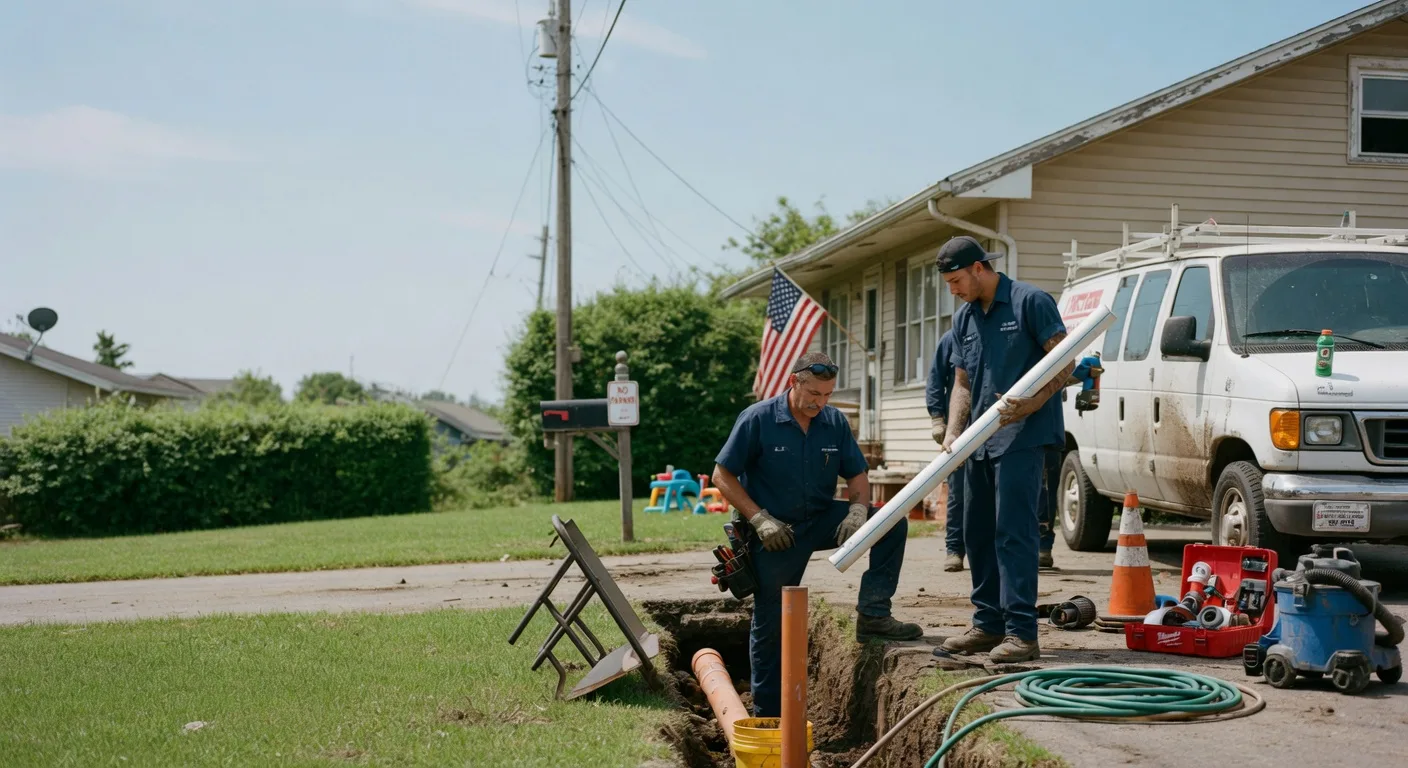
What is the difference between a septic system and a city sewer line for drain problems?
The two systems fail in different places, so the first job is knowing which one your home has. A city sewer line carries wastewater from your house to a municipal main, so trouble is usually confined to the pipe: roots at a clay joint, a bellied section, scale in old cast iron, or a blockage in the lateral. Every drain in the house backing up at once typically means the private line or the connection at the street. A septic system adds a buried tank and a drain field. Solids settle in the tank, and liquid flows out through perforated pipe into the soil. Slow drains or backups can mean a tank that is full and overdue for pumping, a clogged outlet filter or baffle, a failing drain field that can no longer absorb water, or a blockage in the short line between the house and the tank. Soggy ground or a strong odor over the tank area points away from the house plumbing. A cable machine or hydro jetting can clear the house line on either system, but jetting into a septic line needs care about where the water and debris end up. Property paperwork, a cleanout location, or the water utility can tell you which system you have. Expert Plumbers Co connects homeowners with an independent local plumber who works on that type of system.
Homeowners often assume a septic problem and a city sewer problem look the same from the bathroom, but there are a few quick clues. On city sewer, a backup after heavy use is usually the private line or the lateral at the street, and neighbors on the same main may have had the same trouble. On septic, the problem tends to build slowly: drains slow down across the house, the toilet flushes weakly, and a patch of lawn stays wet or unusually green. A common mistake is pouring additives into a septic tank hoping to fix a failing drain field. They do not repair soil that has stopped absorbing water. When you call, tell the plumber how old the system is, when the tank was last opened, and where the cleanout or lid sits. In older homes the tank may be buried deeper than expected and need to be located first, which adds time before any repair starts.
What is trenchless sewer repair and when is it an option?
You have been told the sewer line may need replacing, and you want to know if that means digging it all up. Trenchless repair avoids that. The plumber works from one or two small access pits, or from an existing cleanout, and either lines the old pipe from the inside or pulls a new pipe through the old path.
It is an option when the line is cracked, offset at a joint, or split by root intrusion at a clay joint, but still runs as one continuous pipe. Cast iron choked with scale can sometimes be lined too, after the scale is cleared. That usually means hydro jetting first, then a camera inspection to confirm the pipe condition.
It is not an option when the pipe has collapsed, when a bellied line holds water and the slope has to be corrected, or when sections are crushed or missing. A liner follows the old path, so a sag stays a sag. Those jobs need open excavation.
The camera inspection decides it. If the main line clogs again after every Drain Cleaning visit, the pipe may be failing, not just dirty.
Cost depends on how deep and how long the line is, how many access points are needed, the materials used, how much has to be opened up or removed above it, and any permit or code requirement. Expert Plumbers Co is a referral service, not a plumbing contractor. Call (380) 262-9173 and we will refer you to a plumber serving Le Mars, IA who can inspect the line.
Before any lining starts, ask the plumber to confirm where every side connection joins the main. Branches such as a second bathroom or a laundry line have to be reopened from the inside once the liner sets, and the camera run afterwards should show each one open. Tell the plumber about earlier backups, the age of the house and any past repairs, because older homes often have clay, cast iron and fiber pipe in the same run, and the liner has to bond to each. The finished pipe is slightly narrower inside, but its surface is smooth, so flow usually improves. Plan around laundry and showers while the liner cures, since the line cannot be used until it has set. Ask for the recording of the finished pipe and keep it with your house papers. It helps if you sell the home, and it shows the next plumber exactly what was installed and where it runs.
There is a soggy strip, a sinkhole or an unusually green line of grass over where my sewer runs. Is that a broken sewer line?
It can be. A wet strip, a dip in the lawn or a stripe of grass that is greener than the rest, all following the path of the sewer, is a classic sign that the pipe is leaking into the soil. Waste water carries nutrients, so the grass above it grows lush while the ground underneath stays soggy.
A sinkhole is more serious. If soil is washing into a cracked or separated pipe, it leaves a void that grows over time. The surface may look fine until the roof of that void gives way. Keep people, pets and vehicles off the area and do not fill it yourself with a quick load of dirt, because the hole will usually return.
Other things can look similar, so check before assuming. A leaking irrigation line, a broken water supply pipe or a downspout discharging at that spot can all soak a strip of lawn. A simple test: shut off every tap and appliance, then look at your water meter. If it keeps moving, the leak is likely on the supply side, not the sewer. If the meter is still, and you also notice slow drains, gurgling, a sewage smell outdoors or backups, the sewer is the stronger suspect.
Safe checks you can do:
Note where the wet or green strip runs and whether it lines up with the cleanout or the path to the street. Reduce water use until the line is looked at.
Stop running water and call now if sewage is surfacing, a hole is opening, or drains inside the house are backing up.
Cleaning alone does not fix a broken pipe. A camera inspection is how a plumber finds the break, shows how far the damage runs and tells whether the pipe is cracked, offset at a joint or collapsed. Repair can then be a spot repair, a liner through the existing pipe, or replacement of a section. Cost is driven by depth, length of pipe affected, what sits on top of it such as a driveway, trees or a patio, how much has to be excavated, the pipe material and permits under local code. To be connected with an independent local plumber in Le Mars, IA, call Expert Plumbers Co on (380) 262-9173.
We had roots cut out of our sewer line a year ago and now it is backing up again. What actually stops them coming back?
Cutting does not stop roots. It clears the pipe so water can pass, but the roots are still alive outside it and they grow back through the same opening. A year is a fairly typical time for a line to fill up again, and sometimes it is faster.
Roots get in where the pipe is not sealed: a joint that has shifted, a hairline crack, a broken section. Tree roots follow moisture, and a sewer pipe leaks a little water and vapor, which draws them in. As long as the entry point is open, regrowth is only a matter of time.
What actually removes the cause is closing that opening. There are three common routes, and the right one depends on what a camera inspection shows.
A spot repair fixes a single bad joint or short cracked section. It makes sense when the rest of the pipe is sound.
A liner is a resin-saturated sleeve that is cured inside the old pipe, sealing joints and cracks along its length. It suits pipes that are cracked or leaking at several joints but are still round and in place.
Replacement is the answer when the pipe is collapsed, badly offset, bellied or made of a material that has failed, such as clay in poor shape.
Chemical products poured into the line, or foaming treatments, may slow some regrowth but do not seal the entry point, so they are not a repair.
Safe checks you can do:
Note when the slow drains started and which fixtures are affected. Mention the earlier root cutting to the plumber, and the approximate date.
Stop running water and call now if sewage is backing up into the house.
If a full repair is not possible right away, scheduled cleaning before the next backup can manage the problem, though it stays a stopgap. Cost depends on how many entry points there are, depth and length, access around trees and hardscape, the method chosen and permits under local code. To be connected with an independent local plumber in Le Mars, IA, call Expert Plumbers Co on (380) 262-9173.
What actually happens when a plumber comes to clear my drain, from the moment he arrives to the last flush?
Most people only see the machine come out of the truck. There is more to the visit than that, and knowing the order helps you tell a careful job from a rushed one.
An independent plumber usually starts with questions. Which fixtures are slow, which are fine, when it started, and whether you have noticed gurgling or a smell. One slow sink points to a branch line. Every drain in the house acting up points to the main line.
Next comes a look at access. That might be a sink trap, a tub drain, a toilet that has to be pulled, or a cleanout outside or in the basement. Floors and cabinets get covered with towels or a drop cloth.
Then the plumber picks the tool. A hand auger or small drum machine suits a sink or shower. A larger cable machine suits a main line. If grease or heavy scale is suspected, hydro jetting may come up instead, and a camera may be suggested before anything else.
The cable goes in and is fed forward by feel. A clog gives resistance, then a change when the cutting head breaks through. Roots, grease and soft paper each feel different, and a careful plumber will tell you what the cable seemed to hit. When the cable comes back out, whatever clings to it is worth a look. Hair, wipe fibers, root hairs or a greasy paste all point to a cause.
After that comes the test flush. Water runs through the fixture, and often through several fixtures at once, while the plumber watches for slow movement, gurgling, or water rising in a neighboring drain. At a cleanout, the plumber watches the flow pass. This step matters most. A line that drains well for ten seconds and then slows is only partly open.
Last, the plumber explains what was found. If the blockage was in the main line, has come back before, or the cable stopped at the same spot each time, a camera inspection is the sensible next step, because a cleared pipe and a healthy pipe are not the same thing.
Cost depends on access, how far the cable has to travel, whether a toilet has to be pulled, and whether extra equipment is needed.
If you need a drain cleared in Le Mars, IA, Expert Plumbers Co can connect you with an independent local plumber at (380) 262-9173.